NEW DELHI — In the heart of one of India's oldest and most celebrated universities, something remarkable happened on Saturday evening.
A Union Minister stood before a room full of young students from India's Northeast — young men and women who have travelled thousands of kilometres from Assam, Manipur, Meghalaya, Mizoram, Nagaland, Tripura, Arunachal Pradesh, and Sikkim to study in the capital — and told them something they perhaps needed to hear more than anything else.
Not that the Northeast is important. Not that the Northeast has potential. But that the Northeast is ready. Ready to lead. Ready to drive. Ready to shape the future of a nation of 1.4 billion people.
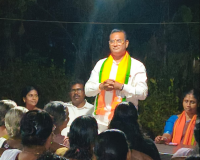
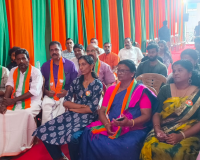
The occasion was NEtym 2026 — the 15th edition of the annual cultural festival of the Northeast Cell at Hindu College, University of Delhi. The speaker was Union Minister for Communications and Development of North Eastern Region, Jyotiraditya Scindia. And the message he delivered was as bold as it was overdue.
Eight States. One Extraordinary Potential.
Scindia did not come to Hindu College with platitudes. He came with a vision — sharp, specific, and unapologetic in its ambition.
"Eight states, one extraordinary potential," he declared. "The Northeast is India's gateway to the Global South."
It is a framing that redefines the region entirely — not as a peripheral corner of the subcontinent requiring charity and attention, but as a strategic powerhouse sitting at the intersection of South Asia and Southeast Asia, uniquely positioned to drive economic and cultural exchange on a global scale.
For a region that has spent decades being described primarily through the lens of its challenges, Saturday's address offered something different and something powerful — a lens of opportunity.
The Numbers That Demand Attention
Scindia backed his vision with a statistic that stops you in your tracks.
The Northeast, he pointed out, has an average literacy rate of nearly 93 percent — a figure that outpaces the national average and places the region among India's most educated populations. In a knowledge economy where human capital is the ultimate competitive advantage, the Northeast is not behind. In critical ways, it is ahead.
"The region's youth must lead India's growth story across sectors," Scindia said — and given the literacy numbers, it was not an empty exhortation. It was a statement grounded in demographic reality.
Hindu College itself provided a fitting backdrop for the message. As the institution approaches its 125th year, it stands as one of India's great centres of learning — and on Saturday, it was filled with the energy of young people from the Northeast who are very much part of that tradition.
A Minister Who Has Fallen in Love With a Region
What made Scindia's address distinctive was not just its content but its evident personal sincerity.
The minister spoke of his familial ties to the Northeast. He described his frequent visits to all eight states — visits that he said continue to inspire and energise his vision for the region's development. He recalled cultural performances from Assam that left him "mantramugdh" — spellbound — describing how every gesture and movement in the region's classical and folk traditions carries within it generations of accumulated meaning and beauty.
He paid tribute to Bhupen Hazarika — the legendary musician and cultural icon whose voice became the soul of the Brahmaputra — and to Zubeen Garg, the contemporary superstar who carries that tradition forward. In doing so, Scindia acknowledged something that policy documents rarely capture: that the Northeast is not just a geographical entity or an economic opportunity. It is a civilisation — deep, layered, and irreplaceable.
"The Northeast remains a repository of unparalleled artistic and cultural wealth," he said. In the room, heads nodded. These students knew it. They had always known it. It mattered, enormously, to hear it said from a national platform.
From Intent to Implementation: The Programmes Making a Difference
Scindia did not limit himself to inspiration. He came with specifics — three flagship programmes that represent the government's concrete commitment to unlocking the Northeast's potential.
The NE SPARKS Programme — implemented in partnership with ISRO — is already changing lives. Each year, 800 students, 100 from each of the eight Northeastern states, gain direct exposure to space science and cutting-edge technology. Eight batches have already completed the programme. In a region where access to advanced scientific education has historically been limited, SPARKS is opening doors that previous generations could not have imagined.
The Ashtalakshmi Darshan Programme takes a different but equally powerful approach — bringing students from the Northeast into meaningful interaction with students from other parts of India, building the human connections that ultimately hold a diverse nation together. Currently covering 1,280 students across 32 batches, the programme is set to scale dramatically — reaching 8,000 students by 2030.
And then there is the Advancing NER Portal — scheduled for launch in April 2026 — perhaps the most ambitious of the three. A single digital platform integrated with the National Career Service, it will provide access to over 1,000 job opportunities, more than 300 career pathways, over 200 entrance examinations, 3,000-plus courses within the Northeast itself, and connections to more than 800 national institutions. For a young person in Kohima or Itanagar trying to navigate the overwhelming complexity of career options and educational pathways, the portal promises to be transformative.
"Under Prime Minister Modi," Scindia said, "the approach to the Northeast has transitioned from intent to implementation. Opportunity must be defined by access and inclusion — not geography."
What the Northeast Is Becoming
Scindia closed his address with a challenge — and an invitation.
"The conversation must move," he said, "from what the Northeast is to what it is becoming — and what its young people are enabling it to become."
It is a subtle but significant shift in framing. The Northeast has spent too long being defined by what it was — by conflict, by remoteness, by marginalisation. The story that is emerging — of a region with 93 percent literacy, of students topping national examinations, of cricket teams winning Ranji Trophies, of young people from Pulwama and Kupwara visiting Parliament and feeling at home — is a different story entirely.
NEtym 2026, Scindia said, is not merely a cultural festival. It is "a powerful expression of identity, aspiration, and India's collective journey towards a Viksit Bharat."
In the room at Hindu College on Saturday evening — filled with music, dance, colour, and the electric energy of young people celebrating who they are and where they come from — that description felt exactly right.
The Northeast is not waiting to be discovered. It is already arriving. And on Saturday night in Delhi, it arrived in style.
NEtym 2026 was organised by the Northeast Cell of Hindu College, University of Delhi. The event featured cultural performances from across all eight Northeastern states.