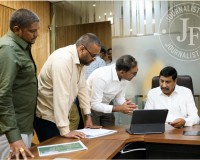
AMARAVATI, SEPTEMBER 3: Andhra Pradesh Chief Minister N. Chandrababu Naidu has directed officials to ensure that no acre of cultivated land is affected by water shortage and to prepare a comprehensive response to the impact of El Niño and deficient rainfall in the State.
At a Cabinet meeting chaired by Mr. Naidu at the Secretariat on Thursday, the government discussed the situation relating to rainfall, agriculture, drinking water, fodder and horticultural crops. Information and Public Relations Minister Kolusu Parthasarathy later briefed the media on the decisions.
52% rainfall deficit
Mr. Parthasarathy said Andhra Pradesh had recorded 52% less rainfall than normal so far and was among the States with the lowest rainfall in the country. Under normal rainfall conditions, about 90% of the cultivable area would have been brought under cultivation by this time, whereas only 60% to 65% had been covered, he said.
The Chief Minister directed agriculture officials to advise farmers on crop choices based on water availability and to discourage cultivation of crops requiring large quantities of water where irrigation resources were inadequate.
90,000 kg of seeds, ₹90 crore subsidy
The government will focus on promoting dryland crops in view of the possibility of reduced irrigation availability. Mr. Naidu directed officials to make 90,000 kg of seeds available to farmers and approved financial assistance of ₹90 crore towards seed subsidies, Mr. Parthasarathy said.
The Minister said farmers would not be forced to change crops. Instead, officials would explain the availability of water, expected yields, market prospects and income potential of alternative crops and enable farmers to make informed decisions.
The Chief Minister also asked Ministers, elected representatives and officials to visit the field and explain the implications of the weather conditions to farmers. Agricultural universities and colleges would be involved in conducting awareness programmes on profitable crops that require less water.
Fodder, horticulture crops
The government has also asked officials to take advance measures to prevent fodder shortages. District-level assessments will be undertaken and fodder cultivation will be encouraged with the participation of the Jee Ram Ji programme, Mr. Parthasarathy said.
Measures have also been proposed to protect horticultural crops that require regular water supply. These include drawing water from nearby tanks through channels, promoting drip irrigation and providing technical assistance to farmers.
Drinking water plan for 14,829 habitations
The government is preparing contingency plans to prevent drinking water shortages if the dry conditions persist. Mr. Parthasarathy said the State had 14,829 habitations and that water availability in each habitation would be assessed separately.
Officials have been asked to identify additional water sources, drill new borewells wherever necessary and arrange tanker supplies in areas facing shortages. In severely affected areas, the government is also examining the possibility of hiring tankers from neighbouring States, the Minister said.
State seeks Central assistance
The Chief Minister directed officials to keep the Centre informed about the rainfall deficit and its impact on agriculture and to submit reports and proposals seeking financial assistance for drought mitigation.
Mr. Parthasarathy said Andhra Pradesh ranked sixth nationally in the implementation of weather-based crop insurance. The government was also working on coordinating funds from the Centre, the State and the Jee Ram Ji programme to address the emerging situation.
NIELIT relocation denied
Mr. Parthasarathy denied reports that the National Institute of Electronics and Information Technology (NIELIT) was being shifted from Tirupati. He said the government was instead working to strengthen artificial intelligence and advanced technology sectors in the State.
He said steps were being taken towards establishing a Quantum AI University in Amaravati and that approvals had been obtained for the establishment of three universities in the State.
Cabinet approves land reclassification in Nellore
The Cabinet also approved the reclassification of 22.31 acres out of 62.70 acres in the Sarvepalli canal area of Nellore Urban mandal in SPSR Nellore district.
The 22.31 acres will be reclassified from ‘Canal Poramboke’ to ‘A.W. Dry’, based on the recommendations of a joint committee, the government said. Active canal areas, hydraulic operational zones and the mandatory 20-foot irrigation right-of-way buffer have been excluded from the reclassification.
The government said safeguards would remain in place to ensure that the water-carrying capacity and maintenance rights of the canal were not affected. The reclassification will facilitate the issue of house-site pattas to eligible poor beneficiaries, it said.
The government’s drought preparedness measures, according to Mr. Parthasarathy, are focused on ensuring irrigation for crops, promoting water-efficient cultivation, protecting livestock and horticulture, and maintaining drinking water supplies as the State monitors the rainfall situation.